

About
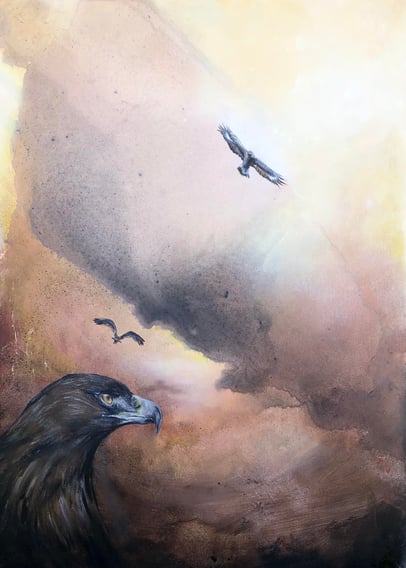
Cecilia Larsdotter works in an abstract and poetic visual language exploring movement, transformation, and relation. Her practice moves between painting and sculptural expressions, where layers, transparency, and intuitive gestures create spaces that invite reflection rather than resolution.
Working primarily with watercolor, acrylic, charcoal, and mixed media, she builds her compositions through a process of adding and removing — allowing traces, fragments, and silence to remain visible. In her sculptural work, she incorporates materials such as plaster and mesh, shaping organic forms that echo the same themes of tension and balance found in her paintings.
Her work is less about depicting something fixed, and more about holding what is in transition — the subtle shifts between inner and outer landscapes, between presence and absence, between self and other.
Influenced by human connection, lived experience, and the invisible dynamics that shape us, her pieces often evoke a sense of recognition without explanation. There is no clear beginning or end — only a moment of pause, where something can be felt, rather than defined.
Through this, Cecilia invites the viewer into a quiet dialogue — one that unfolds in the space between what we see, and what we sense.

Img 0791


Inspiration
I don’t start with ideas.
I start with a disturbance.
Something shifts — barely visible, but impossible to ignore. A tension, a fracture, a quiet pull beneath the surface. That’s where the work begins.
I’m not interested in what is clear.
I’m interested in what resists clarity.
The space between people.
Between what is felt and what is said.
Between control… and surrender.
Nature doesn’t inspire me as an image — it challenges me as a force. Water, especially. It moves without asking permission. It erodes, carries, dissolves. It reminds me that transformation is not gentle. It’s necessary.
My work is shaped by lived experience — not as story, but as residue. What remains after something has shifted. After certainty breaks. After you no longer recognize the version of yourself you once trusted.
Music, poetry, silence — they are not influences. They are entry points. Ways to bypass explanation and stay with what is raw, unresolved, and true.
I don’t create to describe.
I create to stay with what I don’t fully understand.
And if the work resonates, it’s not because it gives answers —
it’s because it refuses to.
Training in intuitive and abstract painting with Swedish artist and fine art teacher Maria Collinder.
Emphasis on developing a personal visual language through layered techniques, composition, and a process-driven approach integrating meditation, movement, and material exploratioN.
Upcoming:
Open for exhibitions, residencies, and gallery collaborations.
Selected exhibitions:
Easter Exhibition (Påskrundan), Bjärehalvöns Saluhall, Sweden, 2025–2026
Englesson Galleries, Pop-up Exhibitions, Sweden, 2017–2018
Galleri Fågel, Beddingestrand, Sweden, 2017–2018
Trelleborg Library, group exhibitions including Art Against Breast Cancer, Sweden, 2018–2019
Layered mixed media built through an intuitive, process-driven approach.
Working with watercolor, acrylic, charcoal, and pencil, I construct and deconstruct surfaces — allowing fragments, traces, and movement to remain.
My sculptural work in plaster and mesh continues the same exploration in three dimensions, where tension, balance, and imperfection are part of the form.
I begin before I understand what I’m doing.
There is no sketch. No plan. Just a first mark — and a willingness to follow it.
I build the work through layers of watercolor, acrylic, charcoal, and pencil, constantly shifting between adding and removing. Surfaces are constructed, broken, and rebuilt. What disappears is as important as what remains.
I’m not trying to control the outcome. I’m testing how much I can let go without losing direction.
The process moves between tension and release, clarity and disruption. I follow what resists me. That’s usually where something real begins.
Traces are left on purpose.
Fragments are not mistakes.
They are evidence.
I don’t finish a painting when it looks complete.
I stop when it no longer asks for anything more.
Similar Artists